STOCKPILES RUN OUT. STARTER CULTURES DON'T.
The Sourdough Paradigm explores how essential human capabilities can survive disruption, move between people and machines, and regenerate without depending on a single controlling center.
● ALL CAPABILITIES & DEPENDENCIES INTACT
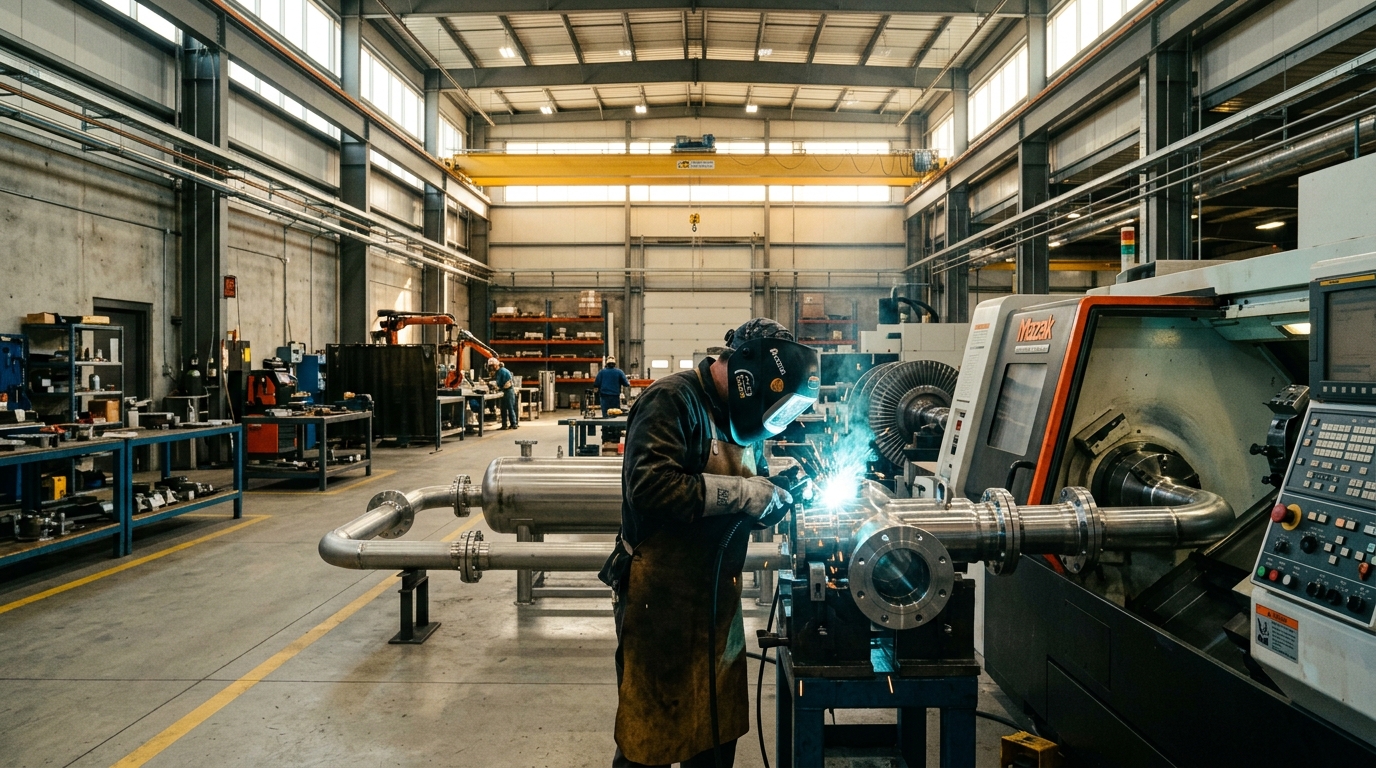
Master practitioner actively holds the 6G orbital keyhole (ΔK = PASS), feeding certified manifolds to hydrostatic testing and turbine dispatch.
Click any optical station marker in the factory view to inspect its physical dependency role, or click ENTER THE LIVING SYSTEM to observe capability loss and regeneration.
Living Culture Conservatory · Distributed Capability Network
PROPOSED· Interactive Network ModelThe culture is the interface.
When an essential capability disappears, the distributed network detects the loss, exchanges a Universal Capability Representation (UCR) starter packet, trains local replacements, tests competence across the 6 conjunctive TPC gates, and attempts regeneration. Touch any cell below or explore the dedicated /living-culture and /living-paradigm conservatories.
QRCI (PROPOSED, not demonstrated): on node loss, replacement cells are recruited while redundant nodes are inhibited to prevent resource contention. The map above demonstrates packet travel, training, and verification — QRCI recruitment itself is not yet a demonstrated mechanism.
Touch any node to trace live regeneration propagation.
Controls
Failure path first, then success path. Every button changes real state.
A: FUNCTIONAL · training 100% · competency 100% · verified yes
B: FUNCTIONAL · training 100% · competency 100% · verified yes
C: FUNCTIONAL · training 100% · competency 100% · verified yes
D: FUNCTIONAL · training 100% · competency 100% · verified yes
E: FUNCTIONAL · training 100% · competency 100% · verified yes
Eight stages (derived from state)
- IDENTIFY — WAITING
- DECOMPOSE — WAITING
- COLLECT — WAITING
- PACKAGE — WAITING
- DISTRIBUTE — WAITING
- RECONSTRUCT — WAITING
- VERIFY — WAITING
- PROPAGATE — WAITING
TPC gates
COMPILER PASS
Gate order: ΔE Energy, ΔM Material, ΔG Geometry, Δτ Time, ΔK Competence, ΔV Verification. One FAIL blocks; passing gates cannot compensate.
Event log
- [tick 0] [info] Network initialized. Five complementary capability nodes connected. No regeneration claim has been made.
SMC / Somatic Symbiosis are cross-tier mechanisms, not tiers. DCIA is PROPOSED and separate. CIP level is not assigned here. Documentation does not establish competence; simulated success does not establish physical feasibility.
Core Epistemic Boundary · Documentation vs. Competence
ESTABLISHED· A Blueprint Cannot Strike an ArcWhat can be written down vs. what has to be taught and verified.
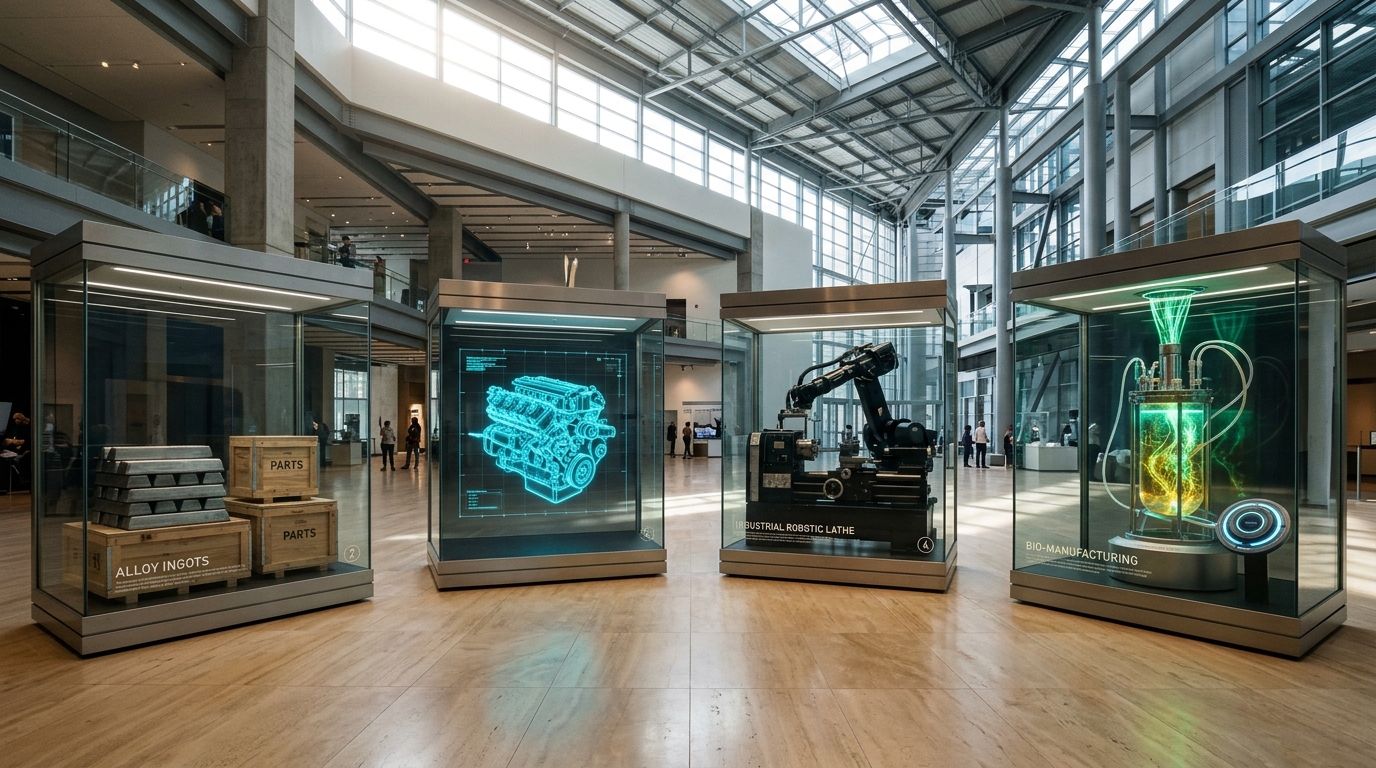 ■ RECORDED ARTIFACTS · STATIC
1. Static Stockpiles, Blueprints & Untended Iron
Stockpiles buffer supply for weeks and then hit zero. Digital CAD files preserve geometry (ΔG) but carry zero tacit operator skill (ΔK = 0). Untended machines halt as soon as material heats drift.
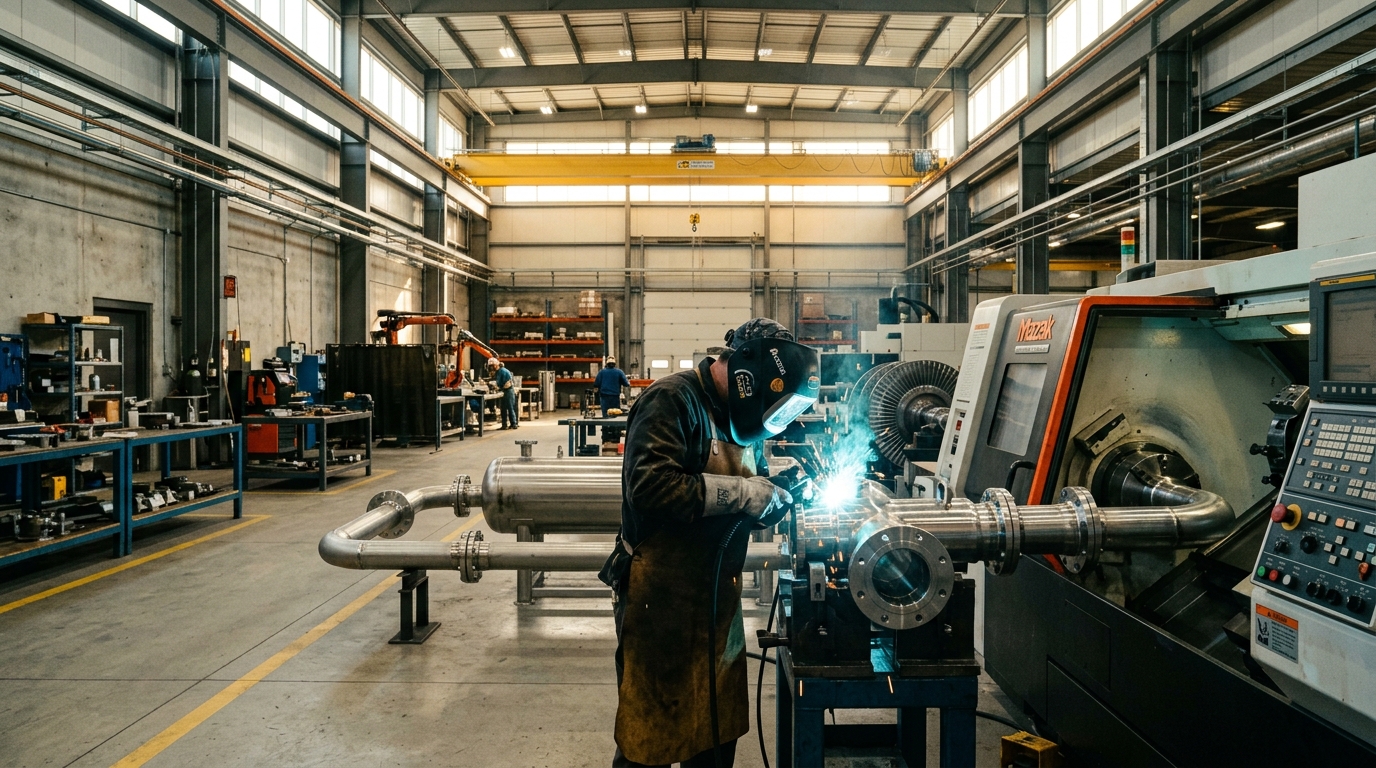 ▨ LIVING CULTURE · DEMONSTRATED & VERIFIED
2. Living Starter Culture (Human → Machine → Human)
Captures Boneyard Specifications, Sensory Maps, Drill Regimens, and Proof Gates in a UCR packet so sister workshops can train local practitioners and independently verify physical output (L4).
Interactive Dependency Topology — Illustrative Comparison
PROPOSED· Conceptual Resilience ModelWhat breaks first when a critical dependency vanishes?
Select a real-world fracture below. Compare single-point dependency against distributed capability regeneration. Copying files never counts as regenerating a physical process.
Active Fracture Scenario: A critical physical skill exists in only one operator's hands.
A — Conventional Single-Point Dependency
SYSTEM HALTEDThe operation stops. Tacit tolerance feel and setup judgment leave with the operator — no verified transfer or independent demonstration exists.
Result: Unverified backup · Zero independent reproduction
B — Sourdough Distributed Regeneration
CAPABILITY REROUTEDSensory cues, setup drills, and proof gates were captured in a UCR packet and independently demonstrated across sister nodes before the loss.
Result: Complementary nodes reconstruct & independently verify output
Origins & Evolution · Deter → Defend → Regenerate
ESTABLISHED· Historical Lineage & Stated ExtensionFrom Deterrence to Survivability to Distributed Regeneration
The Sourdough question extends a strategic progression — as an original philosophical extension by Michael Crumly, not an official successor to Singaporean defence doctrine. Select any milestone below to inspect its historical basis, limits, and principle.
2025 — Sourdough Paradigm (Michael Crumly, Canada)
REGENERATE — Resilience through distributed regeneration.Learn (Historical Context): An original philosophical extension (distinct from Singaporean defence doctrine): can essential capabilities be preserved, transferred, reconstructed, and regenerated elsewhere when their original source disappears?
Structural Limits: Governing doctrine is ESTABLISHED as stated philosophy; the technical stack (UCR, UCA, TPC, CIP, PAC, DCIA, QRCI) is PROPOSED, and open problems R1 and R2 remain UNRESOLVED.
Apply (What Carries Forward): Shifts resilience from protecting stockpiles to propagating starter cultures — independent reproduction verified by physical evidence.
Historical provenance note: Pak Shun Ng's 2005 paper, From “Poisonous Shrimp” to “Porcupine”, is a later historical analysis of Singapore's transition — not a fourth doctrinal stage and not the origin of the Porcupine concept. Biological metaphors are sources of inspiration, never empirical proof of computational or industrial architectures.
Learn the Philosophy · Preserve → Reproduce → Connect → Coordinate
ESTABLISHED· Conceptual DistinctionsPreserve the ability to reproduce, not just the product.
Protecting physical assets, archiving documents, transferring skill, and regenerating a working capability across independent nodes are distinct steps. Documentation alone never equals operational competence.
STAGE 01
PRESERVE
Capture specifications, processes, sensory cues, and boundary conditions before the original source disappears.
STAGE 02
REPRODUCE
Transfer capability to new people, workshops, and machines. Independent physical performance must be demonstrated.
STAGE 03
CONNECT
Organize complementary capabilities into explicit dependency architectures with verifiable interfaces.
STAGE 04
COORDINATE
Investigate how independent nodes cooperate, allocate resources, and reconcile physical state without a single permanent centre.
Signature Interactive Workbench — Illustrative Educational Model
PROPOSED· 8-Stage Regeneration ModelRegenerate a Lost Capability: Load-Bearing Steel Bracket Scenario
An essential manufacturing workshop is gone. Work through the 8 stages and toggle distributed Nodes A–E below to see where regeneration fails when equipment, material expertise, or independent testing is missing.
Stage 1/8: Identify
Objective: Define the essential load-bearing function that must be recovered.
If Missing: A clear output specification (load rating, geometry, duty cycle).
Failure Mode: Rebuilding the wrong bracket well — a part that fits nothing.
Evidence Required to Proceed: Written output specification locked before decomposition.
Distributed Capability Network (Nodes A–E) & Verification Gate
Toggle any node off to inspect system degradationDistribution is not copying files to five servers. It is connecting complementary physical capabilities across independent nodes so no single node failure kills the craft — and no capability is declared regenerated until Node E independently verifies physical output.
Execute Physical Verification Steps (Requires Corresponding Nodes Online):
Interactive DCIA & Sourdough Workbench — Canonical Spec, Nov 1, 2026
Stockpiles run out. Starter cultures don't.
Trade with everyone. Depend on no single one. Scrub the 90-day supply cutoff and watch the two models diverge.
MODEL A — STATIC STOCKPILE
50%
Depletes to 0% by day 90. No regeneration.
MODEL B — SOURDOUGH STARTER (UCR + TPC + CIP)
82%
Regenerates toward 100% capacity. Illustrative model, not experimental proof.
CANONICAL 5-TIER PAC STACK — UCR ≠ UCA
Universal Capability Representation. UCR ≠ UCA. UCR is the packet: what the capability is, written down. It is not the architecture that moves it.
UCR 4-BLOCK PACKET INSPECTOR (tied to the Steel Bracket Workbench below)
Block 1 — Boneyard Specification. Nominal specs, salvaged substitutes, offsets, contamination limits.
TPC 6-GATE FEASIBILITY CALCULATOR — TPC(A) = ∏ vᵢ, i = 1..6
Tap a gate to cycle PASS → FAIL → UNRESOLVED. One FAIL zeroes the product. One UNRESOLVED (with no FAIL) leaves it conditional.
TPC(A) = 1 — PASS. ΔV is LOCKED while any other gate fails — verification cannot pass a broken compile.
CIP MATRIX — MATURITY (C₀–C₄) × EVIDENCE (E₀–E₅), KEPT SEPARATE
Selected: C2 Assisted reproduction with E2 Recorded evidence. High maturity with weak evidence is not the same claim as low maturity with strong evidence — the two axes do not collapse into one score.
G.W.A.P. OS: field interface for the packet on the shop floor. Larogic: Ancords, Lararium, Kinfract — evidence, not impersonation.
FALSIFICATION LABS — R2 LEASE-AUTHORITY & R1 BRANCH ABANDONMENT
Full R1/R2 simulators also live at /preview/visual-sprint-1 and /preview/interactive-modules.
CANONICAL COMPONENT REGISTRY
- ■ ESTABLISHED DOCTRINE — UCR, UCA, TPC (six gates), CIP C₀–C₄ vs E₀–E₅, PAC Tier 5 as architecture
- □ PROPOSED — PAC as planetary runtime, DCIA, QRCI (recruit replacements on loss, inhibit redundant nodes — proposed, not demonstrated)
- ● UNVALIDATED RESEARCH — SMC / Somatic Symbiosis
- ⊠ EXCLUDED — GKS, ASM, PHA, DACA (excluded from the top level by the canonical registry)
Interactive Hardware & Competence Modules
Test the 6-Gate Breaker, UCR Packet Assembler, and γ-Assist Fader
VIS-03 // THERMODYNAMIC PHYSICAL COMPILER (TPC)
Six Physical Gates: trip any switch
Conjunctive Physical Law: All six gates (ΔE, ΔM, ΔG, Δτ, ΔK, ΔV) must be satisfied. One failed gate blocks the operation; an unresolved physical condition remains unresolved.
VIS-01 // UNIVERSAL CAPABILITY RECORD (UCR)
UCR Four-Block Assembler: what travels
Uncheck any block and try to transmit. UCR Packet (Boneyard Specification, Sensory Map, Drill Regimen, Proof Gate) transfers across the network. The package travels; the expert does not. The receiving facility must still calibrate local materials, train its local operator, and pass local ΔV inspection.
VIS-06 // SOMATIC SYMBIOSIS & PROGRESSIVE ASSISTANCE
The γassist fader: assisted success ≠ competence
Assisted execution at γassist = 0.7. Competence is NOT yet established.
Research Architecture · Five Canonical Tiers
PROPOSED· Canonical Capability StackFive Tiers, One Job Each — Grounded by the Thermodynamic Physical Compiler
Each layer has a strict boundary. Software representations (UCR, UCA) cannot bypass physical feasibility (TPC) or claim verified maturity (CIP) without measured shop-floor evidence.
TPC(A) = ∏ vᵢ = ΔE × ΔM × ΔG × Δτ × ΔK × ΔV
Surplus in one gate cannot compensate for a zero in another. Toggle any vector below to verify the non-compensatory rule:
UCR
Universal Capability Representation
Boneyard Spec, Sensory Map, Drill Regimen, Proof Gate.
UCA
Universal Capability Architecture
Dependency graph connecting skills, tools, and interfaces.
TPC
Thermodynamic Physical Compiler
Six-gate physical feasibility check: PASS, FAIL, UNRESOLVED.
CIP
Capability Into Progress
Maturity (C0–C4) tracked separately from Evidence (E0–E5).
PAC
Planetary Autonomous Compiler
Network-scale viability and recovery (Proposed, not runtime).
Connecting agents does not automatically produce collective intelligence
PROPOSED· DCIA & QRCI SpecificationFalsification Before Endorsement · Two Bounded Open Problems
UNRESOLVED· Open for Formal CounterexamplesDon't endorse the architecture. Break it.
We invite researchers, distributed-systems engineers, and industrial architects to falsify two explicit open problems with a counterexample, formal model, failure trace, or experiment (under 2 pages).
R1 — Physical Workflow Branch Reconciliation
UNRESOLVEDCheckpoint DAGs merge digital branches by union, keeping conflicting branches as explicit siblings. But merging digital state cannot undo an irreversible physical cut, weld, or shipment.
Event Lifecycle State Machine:
PROPOSED → AUTHORIZED → ISSUED → ACKNOWLEDGED → EXECUTED → MEASURED → RECONCILED
FAULT TRACE: Branch A reached EXECUTED (steel cut) during partition while Branch B authorized conflicting geometry. Digital merge leaves an unrecoverable physical conflict — state held UNRESOLVED for human/physical review.
R2 — Lease-Authority Consensus & Fencing
UNRESOLVEDDCIA specifies a lease-authority set (LA): E1 single writer per resource, E2 strictly increasing fencing epoch, E3 minority-failure tolerance, E4 joint-consensus membership change.
Partition Trade-off (Safety vs. Liveness vs. Availability):
Receiving physical resource MUST reject stale epoch tokens (e < e_max).
SAFETY PRESERVED: Delayed packet from stale lease holder (epoch 11) arrives after new quorum grant (epoch 12). CNC controller rejects epoch 11.
Research Integrity & Searchable Epistemic Registry
One Acronym · One Meaning · History PreservedWhat is Established, Proposed, Speculative, Unresolved, or Superseded?
Logic owns editorial rights. Evidence determines acceptance. Reproducibility establishes verification. No proposed threshold or AI output is promoted to an established result without independent physical reproduction.
Governing Doctrine & Capability Regeneration Philosophy
Stated governing doctrine: preserve the ability to reproduce essential capabilities across independent nodes rather than stockpiling static products.
Falsification / Boundary: Demonstrating that static stockpiles or centralized documentation alone reliably regenerate complex physical production after total primary-site loss.
Universal Capability Representation
Individual capability packet: Boneyard Specification, Sensory Map, Drill Regimen, and Proof Gate. Possessing documentation is not competence.
Falsification / Boundary: Showing a UCR packet fails to transfer reproducible physical competence across independent operators when all 6 TPC gates are satisfied.
Universal Capability Architecture
Structural grammar connecting capabilities, dependencies, resources, skills, processes, and network topology.
Falsification / Boundary: Cyclic or unresolvable dependency deadlocks during multi-node capability composition.
Thermodynamic Physical Compiler
Physical feasibility gate: TPC(A) = ∏ vᵢ across ΔE (energy), ΔM (material), ΔG (geometry), Δτ (time), ΔK (competence), and ΔV (verification).
Falsification / Boundary: Any action passing TPC(A) = 1 that violates physical conservation, geometric tolerance, or operator safety bounds on the shop floor.
Capability Into Progress
Dual-scale progression tracking Capability Maturity (C0–C4) strictly separated from Evidence Quality (E0–E5 / L0–L4). Calibration criteria remain proposed.
Falsification / Boundary: Promoting a capability to C4 maturity on architectural plausibility (E0/E1) without independent physical reproduction (L4).
Planetary Autonomous Compiler
Long-horizon network-scale viability, recovery, and adaptation layer. Proposed research architecture — not a demonstrated planetary runtime.
Falsification / Boundary: Inability to bound coordination overhead or resolve physical branch conflicts (R1) across distributed nodes.
Distributed Collective Intelligence Architecture
Proposed coordination architecture without a permanent central controller. Requires formal specification, implementation, and empirical validation.
Falsification / Boundary: Failure to maintain safety under network partition or split-brain lease authority (see Open Problem R2).
Quorum-Regulated Capability Recruitment and Inhibition
Proposed mechanism inside DCIA inspired by biological quorum sensing to regulate node recruitment and contention inhibition. Analogy is inspiration, not proof.
Falsification / Boundary: Oscillation, starvation, or spoofed recruitment signals under delayed, duplicated, or adversarial message conditions.
Guy With A Phone OS — Field Interface
Shop-floor interface putting capability records, drills, diagnostics, and evidence capture where physical work happens.
Falsification / Boundary: Field workflow friction that degrades operator safety or mistakes mobile form entry for verified physical output.
Accountability & Evidence Ledger (Ancords, Lararium, Kinfract)
Forensic accountability layer enforcing 'A blueprint cannot strike an arc' and 'Evidence, not impersonation.'
Falsification / Boundary: Allowing unverified AI-generated claims or unmeasured digital state to register as completed physical evidence.
Workflow Branch Abandonment Under Physical Execution
Checkpoint DAGs merge by union, keeping conflicting branches as explicit siblings. Digital merge cannot undo an irreversible physical cut, weld, or shipment.
Falsification / Boundary: A trace where diverging branches execute conflicting physical actions before reconciliation, leaving an unsafe or unrecoverable physical state.
Lease-Authority Consensus Correctness & Fencing
Single-writer lease authority (E1–E4) with strictly increasing fencing epochs enforced by the receiving physical resource.
Falsification / Boundary: A trace producing two concurrent valid leases, same-epoch grants, or stale-holder execution on a resource unable to enforce fencing.
Human Capability Regeneration Research Area
Exploratory human skill-transfer research area. Unvalidated until an independent operator reproduces a physical capability purely from the protocol.
Falsification / Boundary: Failure of independent human subjects to outperform baseline training controls on blind physical fabrication tasks.
Historical & Superseded Formulations
Excluded from the current top-level canonical architecture (PHA/GKS/ASM/IME/NKTP lack distinct validated boundaries; DACA overlaps DCIA). Preserved for historical provenance only.
Falsification / Boundary: N/A — retained strictly in the historical archive; not active claims.
Canadian Industrial Crucible · Case Study Zero
PROPOSED· Industrial ApplicationBuild what can be regenerated in Canadian-controlled shops.
Canada is Case Study Zero for the Sourdough Paradigm — applying distributed capability preservation and verification to Canadian-controlled physical manufacturing and shop-floor resilience. Strategic doctrine is ESTABLISHED; field tooling and industrial deployment architectures remain PROPOSED and evaluated by measured hardware output rather than policy slogans.
About & Direct Epistemic Sparring
ESTABLISHED· Open Review ProtocolChallenge it with evidence.
Authored by Michael Crumly (Regina, Saskatchewan, Canada). Agreement is never required — empirical evidence, formal counterexamples, and shop-floor failure traces are. If a component fails a test, documenting that failure on the public ledger is real progress.
— Mike · Logic has to be an option.
Interactive Scenario Evaluation
A capability has been lost. Can you bring it back?
Don't just read about regeneration — run it. Four actions, four problems, one distributed network. Stockpiles run out. Starter cultures don't.